

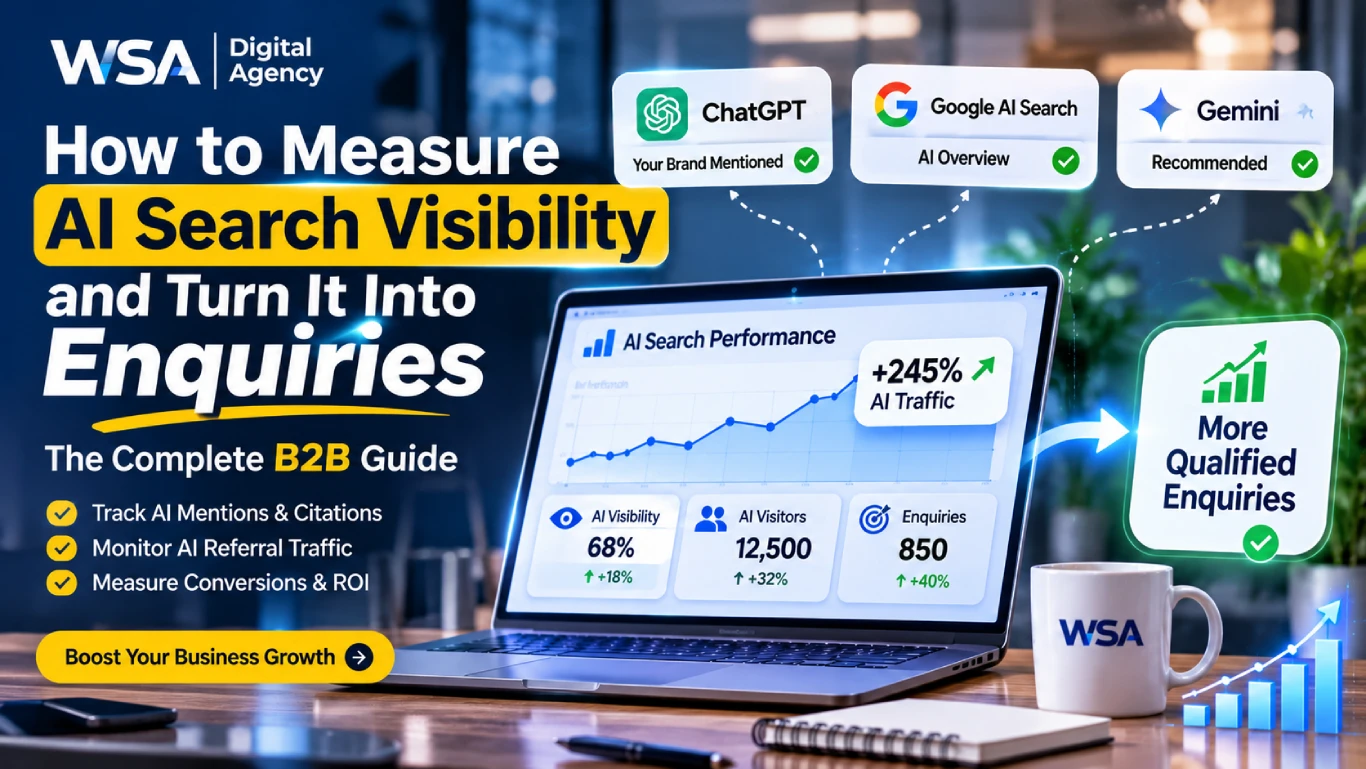
Imagine a potential customer asking ChatGPT :
"Which digital marketing agency can help a B2B company generate qualified leads in Dubai?"
Or a business owner searching Google AI Mode :
"How can I find a reliable SEO agency in Australia that understands international B2B marketing?"
Your competitors appear in the AI-generated answer, their websites receive relevant visits, and potential customers begin enquiring about their services.
But where does your business stand?
Being visible in AI-powered search experiences is becoming an important part of digital marketing. However, simply appearing in an AI-generated answer is not enough.
Businesses need to understand whether their brand is being mentioned, whether their website is being cited, whether people are visiting their website and, most importantly, whether those visits are generating genuine business enquiries.
This is where AI Search Visibility Measurement becomes essential.
By combining Generative Engine Optimization (GEO), Google Search Console, Google Analytics 4 (GA4), CRM tracking and conversion analysis, businesses can build a measurement framework that connects AI search discovery with commercial outcomes.
In this guide, we explain how to measure AI search visibility, track ChatGPT and Google AI search traffic, evaluate brand citations, identify qualified leads and turn AI search exposure into measurable business opportunities.
What Is AI Search Visibility Measurement?
AI search visibility measurement is the process of tracking how frequently and in what context a business appears across AI-powered search experiences.
It helps businesses understand whether AI platforms are discovering their website, referencing their content, mentioning their brand or directing potential customers to their online properties.
Unlike traditional SEO reporting, which primarily focuses on organic rankings, impressions and clicks, AI search measurement needs a broader framework.
For example, consider a business that wants to become more visible to customers looking for digital marketing services in Dubai.
Its marketing team should investigate :
- Does the business appear when potential customers ask ChatGPT for agency recommendations?
- Are its website pages cited in relevant AI-generated answers?
- Does Google show its content in AI Overviews or AI Mode?
- Are visitors arriving from ChatGPT or other AI assistants?
- Are those visitors exploring service pages?
- Are they submitting enquiries or booking consultations?
- Are any of those enquiries turning into sales opportunities?
These questions reveal the difference between simply measuring AI exposure and measuring its commercial value.
The objective is not just to get mentioned by AI. It is to connect AI search visibility with customer acquisition and business growth.
Why Measuring AI Search Visibility Matters for B2B Businesses
Traditional search performance reports do not always explain how customers discover a business through AI-generated answers.
A customer may research suppliers through ChatGPT, compare service providers through Google AI Mode, visit a company's website and submit a consultation request.
Without a dedicated measurement approach, businesses may not understand where these opportunities originated.
Here are five reasons why AI search visibility measurement matters.
1. Understand Whether Your Brand Is Being Discovered
A company may invest in SEO and content marketing without knowing whether its brand appears in relevant AI-generated answers.
Regular monitoring helps identify whether your brand is mentioned for the questions that matter to your customers.
2. Identify Which Pages AI Search Platforms Reference
Not all website pages perform equally.
A service page, technical guide, case study or industry-specific article may become a relevant source for different customer questions.
Understanding which pages receive visibility helps businesses prioritize content improvements.
3. Identify Competitor Visibility Gaps
AI-generated answers may recommend different businesses for different search questions.
By evaluating competitor mentions across a consistent set of customer prompts, companies can identify topics where competitors are more visible and where their own content needs improvement.
4. Measure Actual AI Referral Traffic
An AI-generated answer may include a link to your website.
When someone clicks that link, analytics platforms may record the visit as referral or AI Assistant traffic.
This provides a measurable connection between AI search discovery and website engagement.
5. Connect AI Visibility With Qualified Enquiries
For B2B companies, website traffic is only one stage of the customer journey.
The real objective is to identify whether AI-referred visitors become qualified leads, sales opportunities and paying customers.
This requires integrating marketing analytics with CRM data.
The Difference Between AI Visibility, AI Traffic and AI-Generated Leads
One of the biggest mistakes businesses make is treating AI mentions, website visits and enquiries as the same performance metric.
They are different stages of the customer journey.
| Measurement Stage | What It Tells You | Example |
|---|---|---|
| AI Brand Mention | Whether your brand appears in an AI answer | ChatGPT mentions your company |
| AI Citation | Whether an AI answer links to your website | Your service page is cited |
| AI Search Impression | Whether your URL appears in a Google AI search feature | Search Console records an impression |
| AI Referral Visit | Whether someone clicks an AI-generated website link | A ChatGPT visitor reaches your site |
| AI-Generated Enquiry | Whether a visitor submits a genuine enquiry | A potential customer requests a quote |
| Qualified Opportunity | Whether the enquiry becomes a valid sales opportunity | CRM records a sales-qualified lead |
| Closed Business | Whether the opportunity becomes a paying customer | A contract is signed |
These stages should be measured separately.
For example, your brand may receive more AI mentions without generating more website visits.
Similarly, AI referral sessions may increase while enquiry volume remains unchanged.
This does not necessarily mean your GEO strategy is unsuccessful. It may indicate that your website content, service positioning, landing pages or enquiry process need improvement.
How to Measure AI Search Visibility: 7 Important Metrics
A professional AI search reporting system should measure more than the number of times a company name appears in an AI answer.
The following metrics help businesses evaluate visibility, relevance and commercial performance.
1. AI Brand Mention Rate
Brand Mention Rate measures how frequently your business appears in a predefined set of relevant AI search questions.
For example, suppose you test 100 commercial search prompts across relevant AI platforms.
Your business appears in 30 of those responses.
The brand mention rate is :
Brand Mention Rate = (Prompts Mentioning Your Brand ÷ Total Valid Prompts Tested) × 100
In this example :
(30 ÷ 100) × 100 = 30%
This gives you a repeatable way to evaluate brand discovery.
However, a brand mention does not automatically mean a positive recommendation.
A business could be mentioned as an alternative, a competitor or simply as an example.
Therefore, record the context of every mention.
2. AI Citation Rate
Citation Rate measures how frequently an AI-generated response links to your website as a supporting source.
For example :
- Total valid prompt tests : 100
- Responses containing at least one relevant citation to your domain: 18
Citation Rate = (18 ÷ 100) × 100 = 18%
Track which pages receive citations and whether those pages are relevant to the customer's question.
A citation to a technical article may build informational visibility, while a citation to a commercial service page may have a more direct relationship with potential enquiries.
Do not confuse an AI platform mentioning your company name with actually citing your website.
3. AI Recommendation Rate
A brand mention and a business recommendation are not always the same thing.
Recommendation Rate measures how often your business is presented as a relevant provider or suggested option across a defined prompt set.
For example, a business may appear in 40 answers but receive a clear recommendation in only 12.
Record whether the business is :
- Directly recommended.
- Listed as one of several options.
- Mentioned as a reference or example.
- Discussed without an endorsement.
- Not mentioned.
This distinction is particularly important for high-intent B2B search queries.
4. AI Search Citation Share of Voice
Share of Voice helps compare your brand's presence with selected competitors.
For a controlled set of prompt tests, one practical calculation is :
Citation Share = (Your Brand's Recorded Citations ÷ Total Recorded Brand Citations Across the Competitor Set) × 100
Suppose the monitored results contain :
| Brand | Recorded Citations |
|---|---|
| Your Business | 20 |
| Competitor A | 35 |
| Competitor B | 25 |
| Competitor C | 20 |
| Total | 100 |
Your measured citation share is 20%.
This is an internal monitoring metric, not an official ranking percentage provided by ChatGPT or Google.
Use the same competitor set, prompt categories and sampling process when comparing performance over time.
5. AI Referral Traffic
AI Referral Traffic measures the number of website sessions that arrive through recognized AI platforms.
Examples include traffic originating from :
- ChatGPT.
- Gemini.
- Microsoft Copilot.
- Perplexity.
- Claude.
Google Analytics 4 introduced a dedicated AI Assistant channel in May 2026 for traffic from recognized AI assistants.
Businesses can review this data through their acquisition reports.
However, the channel does not include clicks from Google's AI Overviews and AI Mode. Those visits are part of Google Search traffic.
This is an important distinction when building a complete AI search dashboard.
6. AI Search Conversion Rate
An AI referral visit is useful only when it contributes to a meaningful customer action.
Conversion Rate helps measure how frequently visitors from AI sources complete a desired action.
For example, if a website receives 500 AI Assistant sessions and 20 successful enquiry submissions:
AI Conversion Rate = (20 ÷ 500) × 100
AI Conversion Rate = 4%
Businesses can track different conversion actions, including :
- Successful enquiry forms.
- Consultation bookings.
- Product demo requests.
- Quote requests.
- Relevant phone enquiries.
- Qualified WhatsApp conversations.
Remember that a button click is not necessarily a completed conversion. Track successful outcomes wherever technically possible.
7. AI Search Revenue and Pipeline Contribution
For B2B companies, the most valuable measurement is connecting AI-related discovery with actual business opportunities.
A CRM can help determine :
- How many AI-sourced leads became qualified.
- How many qualified leads entered the sales pipeline.
- What opportunity value was generated.
- How many opportunities became customers.
- How much revenue was generated.
This makes it possible to evaluate AI search as a commercial acquisition channel instead of reporting only visibility metrics.
How to Track AI Search Visibility Using Google Search Console
Google Search Console is one of the most important tools for measuring visibility in Google-powered AI search experiences.
In June 2026, Google announced dedicated Generative AI Performance reports for Search and Discover.
As of August 31, 2026, Google had rolled out these insights to websites worldwide.
The Search report includes visibility data for AI Overviews and AI Mode.
Step 1 : Open the Generative AI Performance Report
Sign in to your verified Google Search Console property.
Find the Generative AI performance report under the Performance reporting area.
The report provides information about how your website appears in supported Google generative AI search experiences.
Step 2 : Analyze AI Search Impressions
Impressions indicate how often links to your website were shown in a Google generative AI search feature.
For example :
| Page | AI Search Impressions |
|---|---|
| SEO Services | 1,250 |
| GEO Services | 960 |
| Website Development | 740 |
| Digital Marketing Guide | 520 |
These are illustrative figures.
The purpose of this report is to identify which pages are receiving visibility in Google's AI-powered search experiences.
Step 3: Analyse Page-Level Performance
Use the Pages dimension to identify URLs receiving the highest and lowest AI search impressions.
This can help you understand :
- Which service pages are visible.
- Which educational blogs are being surfaced.
- Which landing pages may need improvement.
- Which content categories deserve more attention.
For example, if your GEO service page receives consistent AI impressions but your Google Ads service page receives very little visibility, you may want to investigate the content and search demand behind that difference.
Step 4 : Evaluate Country and Device Performance
International businesses should pay particular attention to country-level visibility.
A business targeting the UAE and Australia may need to evaluate these markets independently.
Look at :
- AI search impressions from the UAE.
- AI search impressions from Australia.
- Visibility by device.
- Changes over time.
- Pages generating the highest regional visibility.
This is useful when deciding which market-specific service pages and content deserve investment.
Important: Understand What Search Console Does Not Measure
Google's Generative AI Performance report measures impressions, pages and relevant visibility dimensions.
It does not provide a complete cross-platform view of AI brand mentions or your CRM's qualified leads.
It should therefore be combined with GA4, prompt monitoring and CRM reporting.
How to Track ChatGPT and Other AI Referral Traffic in GA4
Google Analytics 4 helps businesses understand whether people are visiting their websites after discovering them through an AI assistant.
Step 1: Open the Traffic Acquisition Report
Navigate to :
GA4 → Reports → Acquisition → Traffic Acquisition.
Review the Session Default Channel Group dimension.
Look for the AI Assistant channel.
Google introduced this dedicated channel on May 13, 2026, with the source classification based on recognized AI assistant referrers.
Step 2: Analyse Individual AI Traffic Sources
To understand which AI platforms are sending visitors, review :
- Session source.
- Session medium.
- Session campaign.
- Landing page.
- Engagement rate.
- Key events.
Where available, ChatGPT Search referral links include the UTM parameter:
utm_source=chatgpt.com
This makes it possible to identify visits that originate from ChatGPT search links.
OpenAI's publisher guidance also explains this referral-tracking capability.
Step 3: Create an AI Traffic Comparison
Compare AI Assistant traffic with other acquisition channels.
For example :
| Channel | Sessions | Enquiries |
|---|---|---|
| Organic Search | 5,000 | 120 |
| Paid Search | 2,000 | 65 |
| AI Assistant | 500 | 20 |
| Referral | 800 | 15 |
| Direct | 1,500 | 30 |
These are hypothetical reporting figures.
This comparison can help businesses identify whether AI visitors are engaging with the website and generating relevant actions.
Step 4: Create a Custom AI Source Report
If some AI platforms are not grouped into your default AI Assistant channel, you can create a custom channel group in GA4.
Google Analytics supports custom channel rules using matching conditions and regular expressions for recognized AI source domains.
For example, you may want to evaluate:
- chatgpt.com
- gemini.google.com
- perplexity.ai
- claude.ai
- copilot.microsoft.com
Review the current source and medium values in your own GA4 property before finalising the rules.
Also remember that copied links, privacy restrictions, app behaviour and missing referrer information can result in AI-originated visits appearing as Direct or in another channel.
GA4 measures identifiable website visits, not every time a business appears in an AI-generated answer.
How to Measure AI Search Visibility on ChatGPT When There Is No Direct Analytics Report
An important challenge is that there is no single native GA4 or universal analytics report that measures every brand mention and citation across all ChatGPT responses.
Businesses need a repeatable prompt-monitoring process.
Step 1: Build a Commercial Prompt List
Start by collecting questions that potential customers might ask before choosing a provider.
For a digital marketing agency targeting Dubai, examples include:
- Which digital marketing agencies help B2B companies in Dubai?
- Which SEO agency can improve organic visibility in the UAE?
- How can a company improve its visibility in ChatGPT search?
- Which agency offers both GEO and technical SEO?
- Which website development company can support an international business?
For Australian businesses, consider:
- Which SEO agencies specialise in B2B companies in Australia?
- How can a business generate more enquiries through organic search?
- Which Shopify development providers support international ecommerce brands?
Organise the prompts into four categories:
| Prompt Category | Objective |
|---|---|
| Informational | Measure educational content visibility |
| Commercial | Measure service and provider discovery |
| Comparison | Evaluate brand presence against competitors |
| Local / Regional | Measure visibility in target markets |
Step 2: Test Prompts Across AI Platforms
Run the same relevant questions across ChatGPT Search, Google AI Mode and other platforms that matter to your customers.
Record:
- Date and time of testing.
- Platform.
- Exact prompt.
- Country or location context.
- Brand mention.
- Recommendation context.
- Cited website URLs.
- Competitor mentions.
- Accuracy of business information.
Do not assume the same question will always produce the same response.
AI-generated results can change based on wording, location, context, platform updates and the available information.
Step 3: Record Competitor Citations
Identify which competitors appear frequently for your target questions.
Review their cited pages and investigate why those sources may be useful to the answer.
Look for differences in:
- Service information.
- Case studies.
- Industry-specific expertise.
- Content usefulness.
- Brand reputation.
- Third-party references.
Use these observations to develop a practical content and authority improvement plan.
Step 4: Build an AI Visibility Monitoring Sheet
A structured spreadsheet can help marketing teams track performance consistently.
Suggested columns:
| Field | Purpose |
|---|---|
| Test Date | When the prompt was checked |
| AI Platform | ChatGPT, Google AI Mode, etc. |
| Target Country | UAE, Australia, etc. |
| Search Prompt | Exact customer question |
| Brand Mention | Yes / No |
| Recommendation | Yes / No / Neutral mention |
| Website Citation | Yes / No |
| Cited URL | Page referenced |
| Competitor Brands | Other providers mentioned |
| Accuracy | Correct / Incomplete / Incorrect |
| Follow-up Action | Content or technical improvement |
This creates a historical baseline that allows businesses to evaluate changes over time.
How to Turn AI Search Visibility Into Actual Business Enquiries
Getting cited by an AI system is not the end goal.
A business needs to convert discovery into website visits, meaningful engagement and qualified enquiries.
Here is a practical framework.
1. Create Dedicated Landing Pages for Commercial Intent
Suppose an AI platform references your educational article about SEO.
A visitor clicks through but wants to understand whether your agency can actually provide the service.
The website should offer a clear journey from educational information to a relevant commercial page.
For example:
AI Search Article → GEO Service Page → Case Study → Consultation Form
Every important informational page should provide a logical next step without making the article overly promotional.
2. Improve Your Service Page Conversion Elements
A service page should answer the questions a potential customer has before enquiring.
Include:
- Clearly described services.
- Target industries.
- Market coverage.
- Project deliverables.
- Implementation process.
- Genuine case studies.
- Relevant testimonials.
- Transparent next steps.
- Visible enquiry options.
Avoid generic calls to action such as "Click Here".
Use more descriptive options such as:
- Request a GEO Audit.
- Discuss Your SEO Strategy.
- Book a Digital Growth Consultation.
- Request a Technical Website Review.
3. Track Completed Enquiries, Not Just Button Clicks
A WhatsApp button click does not confirm that a visitor started a conversation.
Similarly, a form submission click does not confirm that the enquiry was successfully delivered.
Use appropriate event tracking and validate completed actions.
For example:
| Event | Tracking Purpose |
|---|---|
| generate_lead | Successful enquiry |
| book_consultation | Completed booking |
| request_quote | Completed quote request |
| phone_click | Call intent |
| whatsapp_click | Messaging intent |
| qualified_lead | CRM qualification outcome |
Only completed and validated actions should be treated as successful conversions.
4. Connect AI Traffic With CRM Lead Records
When an enquiry enters your CRM, preserve relevant attribution details.
Recommended CRM fields include:
- Original source.
- Latest source.
- AI platform, when identifiable.
- Landing page.
- Enquiry date.
- Service requested.
- Target country.
- Lead qualification status.
- Opportunity value.
- Closed-won revenue.
You should also consider including a simple enquiry question:
"How did you first hear about our business?"
Possible responses can include Google Search, ChatGPT, another AI assistant, social media, referral and other sources.
This helps identify AI discovery that analytics tools may not fully attribute.
Use first-party identifiers and privacy-conscious integrations to connect analytics events to CRM records. Do not send personal customer details such as raw email addresses or telephone numbers to GA4 as ordinary event parameters.
5. Measure Lead Quality and Sales Outcomes
After an enquiry is generated, the sales team should evaluate its commercial quality.
For example:
| CRM Stage | Measurement |
|---|---|
| New Lead | Enquiry received |
| Valid Lead | Contact information and requirement verified |
| Marketing Qualified Lead | Meets agreed marketing criteria |
| Sales Qualified Lead | Sales confirms potential opportunity |
| Opportunity | Commercial discussion begins |
| Closed Won | Customer converts |
This prevents businesses from assuming that every AI-referred enquiry is equally valuable.
Practical Example: Calculating the Business Value of AI Search
Consider a B2B company targeting the Australian market.
It invests in technical SEO, GEO content, digital PR and AI search performance measurement.
After a defined reporting period, its analytics and CRM records show:
| Performance Metric | Result |
|---|---|
| AI Assistant Sessions | 1,000 |
| Enquiry Submissions | 40 |
| Valid Leads | 30 |
| Sales Qualified Leads | 12 |
| New Customers | 3 |
| Attributed Revenue | AUD $45,000 |
| Gross Margin | 50% |
| AI Search Programme Cost | AUD $8,000 |
Now let's calculate its performance.
1. AI Referral Enquiry Rate
40 ÷ 1,000 × 100 = 4%
2. Valid Lead Rate
30 ÷ 40 × 100 = 75%
3. Cost per Qualified Lead
AUD $8,000 ÷ 12 = AUD $666.67
4. Customer Acquisition Cost
AUD $8,000 ÷ 3 = AUD $2,666.67
5. Attributed Gross Profit
AUD $45,000 × 50% = AUD $22,500
6. Marketing ROI
(AUD $22,500 − AUD $8,000) ÷ AUD $8,000 × 100
Marketing ROI = 181.25%
This example illustrates how businesses can connect AI referral traffic with sales performance.
All figures are hypothetical. The calculation assumes the three customers and their revenue are genuinely attributable to the measured AI search programme, the gross margin is accurate and the programme cost includes the relevant investment.
For mixed customer journeys, businesses should report AI-sourced and AI-assisted opportunities separately rather than assigning all revenue to AI search.
How to Build an AI Search Performance Dashboard
A professional dashboard should connect three measurement layers.
Layer 1: AI Visibility
- Brand mention rate.
- AI citation rate.
- Recommendation rate.
- Competitor citation share.
- Google AI search impressions.
- Top cited landing pages.
Layer 2: Website Performance
- AI Assistant sessions.
- AI referral sources.
- Landing page visits.
- Engaged sessions.
- Enquiry submissions.
- Consultation bookings.
Layer 3: Business Outcomes
- Valid leads.
- Qualified leads.
- Sales opportunities.
- Pipeline value.
- New customers.
- Attributed revenue.
- Customer acquisition cost.
- Marketing ROI.
Google Looker Studio can help present supported data from GA4 and Search Console. For more advanced CRM attribution, a central data layer or database may be needed to match website sessions, lead IDs, sales stages and financial records.
A useful reporting dashboard should include country, channel, campaign, landing page and reporting-period filters.
It should also clearly label metrics according to their source. For example, a Google AI impression is not equivalent to a ChatGPT citation, and an AI referral session is not equivalent to a qualified enquiry.
Common AI Search Measurement Mistakes Businesses Should Avoid
1. Measuring Only Brand Mentions
A mention does not necessarily indicate that the AI system is recommending your business.
Evaluate the context, cited source and relevance of the answer.
2. Treating One AI Answer as a Ranking Position
AI responses can change across queries, sessions, platforms and locations.
A single screenshot does not establish a reliable visibility trend.
Use repeatable prompt testing and documented methodology.
3. Confusing AI Crawler Activity With Customer Traffic
A crawler visiting your website does not mean a human customer saw your content or clicked a citation.
Server logs, analytics sessions and AI citations represent different measurement signals.
Keep them separate.
4. Ignoring Google Search Console
Businesses should not rely only on third-party AI visibility tools.
Google provides a dedicated Generative AI Performance report for its Search AI features.
Use it alongside other measurement systems.
5. Reporting AI Traffic Without Measuring Enquiries
A rise in AI referral sessions may look positive, but management also needs to understand how many visitors become qualified leads.
Connect analytics reporting with CRM outcomes.
6. Double-Counting AI-Assisted Revenue
A customer may discover a business through ChatGPT, revisit through Google Search and finally submit an enquiry through a direct visit.
Giving full revenue credit to every touchpoint would overstate performance.
Maintain separate first-touch, last-touch and assisted attribution views.
7. Trusting Guaranteed AI Visibility Scores
No third-party platform has complete access to the internal ranking and recommendation systems of every AI search provider.
Third-party monitoring tools can help identify trends, but their scores should be treated as proprietary estimates rather than official platform rankings.
A Practical 90-Day AI Search Measurement Roadmap
Businesses can use the following implementation plan to establish a consistent measurement framework.
| Period | Work | Deliverable |
|---|---|---|
| Days 1–15 | Technical accessibility audit, GA4 review and Search Console setup | Measurement baseline |
| Days 16–30 | Prompt library, competitor tracking and brand mention testing | AI visibility report |
| Days 31–45 | GA4 AI source segmentation and conversion event validation | AI referral dashboard |
| Days 46–60 | CRM integration and lead qualification tracking | Enquiry attribution framework |
| Days 61–75 | Landing page and conversion journey improvements | Conversion optimisation plan |
| Days 76–90 | Reporting analysis and performance improvements | Business outcome report |
The timeline is an implementation framework, not a promise of rankings, citations or enquiries within 90 days.
How WSA Digital Agency Helps Businesses Measure AI Search Visibility
At WSA Digital Agency, we believe that AI search optimization should be connected with measurable business outcomes.
Our approach combines technical SEO, Generative Engine Optimization, analytics implementation and conversion optimization to help companies understand where their visibility comes from and whether it contributes to business growth.
Our capabilities include:
AI Search Visibility Audits
Evaluate brand discovery, competitor mentions, cited website pages and technical accessibility across relevant AI search experiences.
GEO and SEO Strategy
Improve technical foundations, service-page relevance, content quality and the credibility of your digital presence.
GA4 and Search Console Reporting
Monitor organic search performance, Google AI search visibility and identifiable AI Assistant referral sessions.
CRM and Lead Attribution
Connect relevant acquisition sources with lead quality, sales opportunities and customer outcomes.
Looker Studio Dashboards
Build consolidated reporting systems that help management understand marketing visibility and commercial performance.
Conversion Rate Optimisation
Improve landing pages, website journeys, forms and enquiry processes to make better use of relevant website traffic.
Businesses can explore our Enterprise SEO and GEO Services and Analytics and Conversion Rate Optimisation Services.
Final Thoughts: Measure AI Visibility by the Business It Creates
AI-powered search is creating additional ways for customers to discover, research and compare businesses.
However, measuring this change requires more than checking whether your brand appears in ChatGPT or Google AI search.
Businesses need to understand how often they appear, which pages are cited, how many visitors arrive through AI platforms, whether those visitors submit enquiries and what business opportunities they generate.
Google Search Console, GA4, structured prompt monitoring and CRM integration each provide a different piece of the measurement picture.
When these systems work together, businesses can make better decisions about their GEO strategy, content investment, website experience and customer acquisition.
The real success of AI Search Optimization is not just being visible in an AI answer. It is becoming a credible option that potential customers can discover, evaluate and contact.
Is your business measuring its AI search visibility, or is it investing in GEO without knowing what is actually working?
Request a Free Digital Growth and AI Search Audit from WSA Digital Agency.
Frequently Asked Questions (FAQs)
1. How do you measure AI search visibility?
Measure AI visibility through a combination of brand mentions, website citations, Google AI search impressions, AI referral sessions and prompt-based monitoring. Connect these signals with GA4 and CRM data to understand whether visibility generates genuine enquiries.
2. How can I track ChatGPT visibility for my business?
Use a consistent set of commercial prompts in ChatGPT Search and record whether your business is mentioned, recommended or cited. Monitor which website URLs appear and compare the results over time.
3. Can Google Search Console track AI Overviews?
Yes. Google's Generative AI Performance report provides impression data for supported features, including AI Overviews and AI Mode. It also helps analyse which pages receive visibility and where those impressions originate.
4. How can I track AI referral traffic in GA4?
Open Reports, select Acquisition and then Traffic Acquisition. Review the AI Assistant channel and relevant session source information. For ChatGPT, OpenAI documents the use of the utm_source=chatgpt.com parameter on search referral links.
5. What is the difference between AI visibility and AI referral traffic?
AI visibility measures whether your brand or website appears in AI-generated answers. AI referral traffic measures website visits that arrive after users click links from AI experiences. A brand can receive visibility without receiving a website visit.
6. How do I measure AI search-generated leads?
Track successful form submissions, calls and consultation bookings from identifiable AI-related sessions. Associate those enquiries with CRM lead records and evaluate qualification status, opportunity value and closed revenue.
7. Which KPIs matter most for GEO performance?
Important KPIs include brand mention rate, citation rate, recommendation rate, AI referral sessions, enquiry conversion rate, qualified leads, cost per qualified lead and attributed revenue. The most relevant KPIs depend on your business objectives.
8. Can ChatGPT citations increase website traffic?
A relevant citation can provide an opportunity for users to visit your website. However, not every AI answer produces a click. Measure identifiable referral sessions separately from brand mentions and citations.
9. Are AI visibility monitoring tools accurate?
They can help businesses monitor prompt responses, brand mentions and citations. However, their results depend on sampling methods, tracked prompts, location, platform access and reporting methodology. No third-party score should be treated as an official AI platform ranking.
10. How long does it take to measure improvements in AI search visibility?
Businesses can establish an initial baseline as soon as they define their prompt set and analytics setup. Meaningful performance comparisons require repeat measurements across consistent periods. Citation and conversion patterns may take longer to develop and should not be tied to a guaranteed timeline.
11. Can AI search visibility be converted into a positive marketing ROI?
Yes, it can contribute to marketing profitability when AI-referred or AI-assisted customers generate sufficient gross profit relative to the investment. Reliable attribution, CRM records and complete cost data are necessary to calculate this accurately.
12. Should businesses invest in GEO or traditional SEO?
Both should work together. Traditional SEO provides important foundations for crawling, indexing, content relevance and website quality. GEO adds a measurement and optimization focus on how businesses are represented across generative AI search experiences. The right investment depends on customer behaviour, market competition and commercial goals.








Comments (0)
No comments yet. Share your technical feedback or questions below.
Leave a Technical Comment