

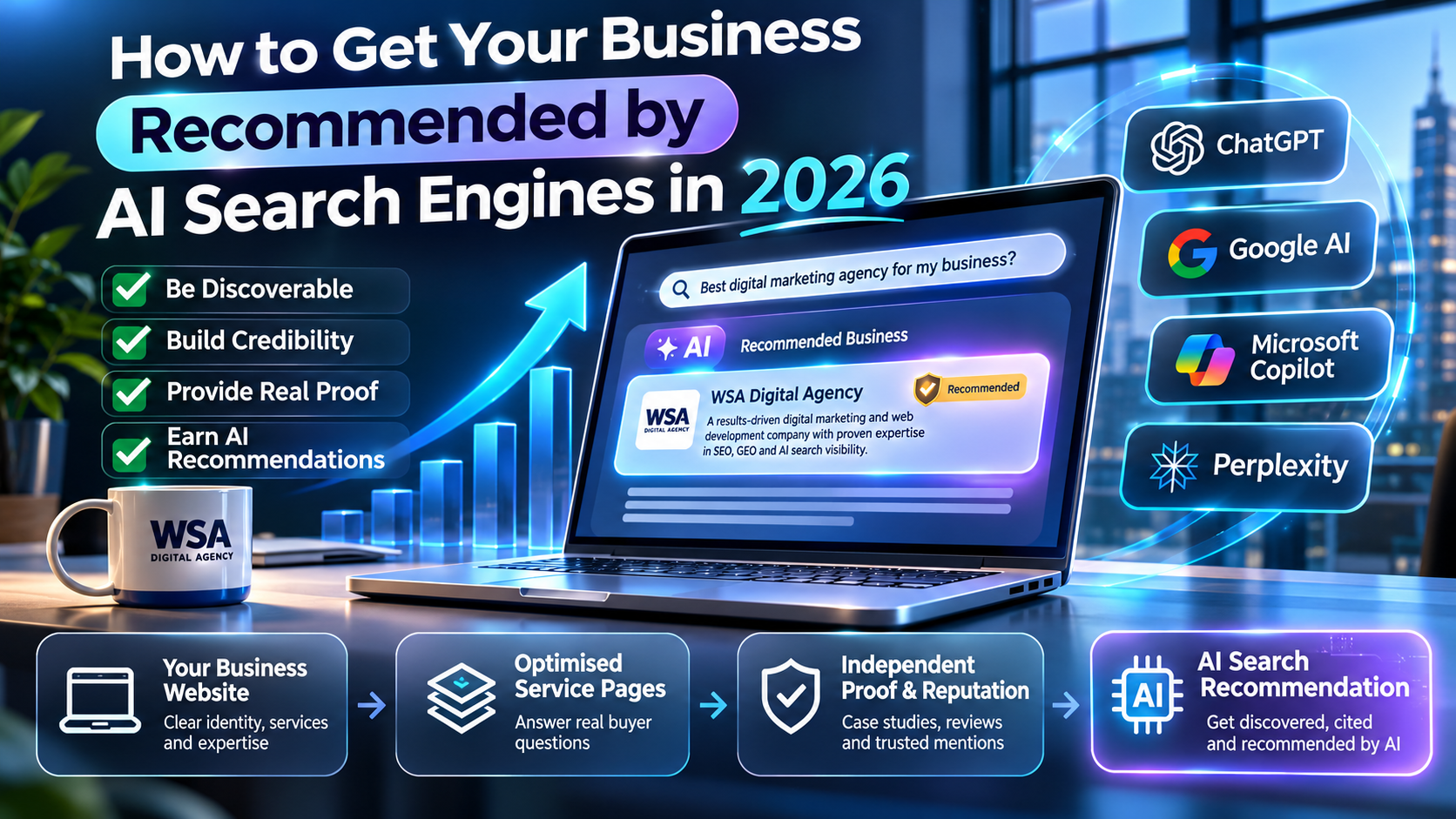
When a buyer asks ChatGPT, Google AI Mode, Perplexity or Microsoft Copilot to recommend a supplier, the answer is not simply a list of websites with the most keywords. AI search experiences retrieve information they can access, assess whether sources answer the question, and assemble a response from material they consider relevant. The process differs by platform, and no agency can guarantee that a business will be named.
Businesses can still improve their chances of being discovered, understood and verified. The objective is not to “trick” AI. It is to become a credible answer to the questions buyers are already asking.
1. Make your business identity unambiguous
Start with the facts a customer needs to verify: your exact business name, what you sell, who you serve, where you operate, and how to contact you. Keep this core information consistent across your website, Google Business Profile, relevant industry listings and professional profiles.
Replace vague claims such as “complete solutions” with specific descriptions. A B2B software company, for example, should explain which business problem its platform solves, which organisations it suits, what it integrates with and where it is available. Keep important facts in readable page text, not only in images, animation or brochures. Clear naming helps search systems distinguish your company from similarly named businesses.
2. Build pages around real buyer questions
A homepage cannot answer every commercial question. Create a focused page for each important service or product, then add supporting pages only when they serve a genuinely different audience, use case or location.
A strong service page explains the problem addressed, who the service suits, what is included, how the process works, relevant locations, limitations, evidence and the next step. Include real project examples, deliverables, credentials or case studies that a buyer can check.
Think about the questions asked in sales conversations : “Which provider handles this type of project?”, “What does implementation involve?” and “Can this supplier support our market?” Use headings and direct explanations to answer them. Do not publish dozens of near-identical city pages or lightly rewritten FAQ's merely to cover every wording variation. Google warns against creating pages primarily to manipulate search or AI visibility.
3. Make priority pages accessible to search systems
Good content cannot be considered if a platform cannot retrieve it. Check that important pages return a successful response, are indexable, use the right canonical URL, appear in your XML sitemap and can be reached through internal links. Review robots.txt, CDN firewalls and security tools to ensure they do not unintentionally block legitimate crawlers.
For ChatGPT search, OpenAI identifies OAI-SearchBot as the crawler used to discover websites for search results. It is separate from GPTBot, which relates to model training. A site can allow OAI-SearchBot while making a separate choice about GPTBot. Check both robots.txt and hosting-level access controls.
For Google AI Overviews and AI Mode, ordinary Search eligibility remains important: pages need to be indexed and eligible to appear with a snippet. Since August 31, 2026, website owners can also manage inclusion in Search generative AI features through Search Console. Bing’s webmaster guidance stresses crawl efficiency, clear URLs, accurate sitemaps and focused, verifiable content.
Use structured data when it accurately describes visible information about your organisation, service, product or article. Treat Schema.org markup as part of sound technical SEO—not a magic AI-ranking switch. Google says no special schema is required for its generative AI features.
4. Publish evidence that buyers can verify
A claim is stronger when a buyer can check it. Replace unsupported superlatives with useful details: project scope, industry, location, timeline, technology, constraints and measurable outcomes. Explain how a result was measured and over what period. Get permission before naming clients or publishing their information.
Useful evidence includes original research, transparent comparison criteria, genuine case studies, product documentation, expert commentary and clear author biographies. Date content when it is published and update it when services, facts or guidance change. Changing a date without making a meaningful update does not create new evidence.
Google’s current guidance emphasises unique, useful, non-commodity content and a clear technical structure. Bing likewise stresses focused material that can be understood and independently verified. A generic article repeating common advice gives an AI system little reason to select it over similar pages.
5. Build a reputation beyond your own website
Your website should not be the only place where buyers can confirm your identity and expertise. Earn relevant coverage through trade associations, credible industry publications, partner websites, professional events and genuine customer references. Keep business listings accurate and respond professionally to customer feedback.
For eligible local businesses, maintain a complete Google Business Profile: category, address or service area, phone, hours, services and website. Ecommerce businesses should maintain accurate product information and use relevant Merchant Center features. These details support local or product discovery; they do not guarantee an AI recommendation.
Prioritise relevance and authenticity over volume. Do not buy fake reviews, manufacture brand mentions or distribute identical promotional text across unrelated websites. Independent confirmation is useful only when it is genuine.
6. Measure AI visibility and business outcomes
AI answers can change with the wording of a question, location, platform and date. A single screenshot is not a measurement. Build a repeatable prompt set from real buyer decisions, such as “best [service] provider for [industry] in [city]”, “compare [solution A] and [solution B] for [use case]” and “which company can handle [specific requirement]?”
Run the same prompts periodically across relevant platforms. Record whether your brand is mentioned or recommended, which pages and third-party sources are cited, whether the description is accurate, and which competitors appear. Separate branded prompts from non-branded prompts so searches already containing your company name do not inflate the result.
Connect visibility to enquiries: referral sessions, forms, calls, qualified leads and closed business. Google’s Generative AI performance report in Search Console, available globally since August 31, 2026, provides impression data for AI Overviews and AI Mode, including page, country and device dimensions. Use it alongside analytics and CRM records; it does not report every AI platform.
AI visibility is only one step in the buyer journey. If visitors reach your website but do not enquire, review the technical and conversion issues that can stop a website generating leads.
What businesses should avoid
There is no reliable shortcut that forces an AI system to recommend a company. Be cautious of guaranteed placements, mass-produced prompt pages, keyword-stuffed FAQs and misleading structured data. Google says llms.txt, artificial content chunking and special AI-only schema do not provide a special advantage in Google Search generative features. These tactics should not replace work that improves the site for customers.
Turn AI visibility into a practical growth plan
Start with a focused audit: confirm that core pages are crawlable, make service and location details precise, strengthen the evidence behind commercial claims, and establish a baseline across buyer-intent prompts. Prioritise improvements according to the questions that influence revenue.
WSA Digital Agency provides SEO and Generative Engine Optimization services alongside web development, digital marketing and analytics. Businesses can review the WSA SEO and GEO service approach or contact the team to discuss their market, technical condition and commercial goals. A credible programme should focus on measurable improvements—not a promise of a guaranteed AI ranking.
Frequently asked questions
Can an agency guarantee that ChatGPT or Google AI will recommend my business?
No. AI answers vary by query, location, platform and time. An agency can improve discoverability, content quality and evidence, but cannot guarantee a mention or recommendation.
Does traditional SEO still matter for AI search?
Yes. Google says its generative search features build on core Search systems. Crawlability, indexing, helpful content and clear structure remain important.
Do I need an llms.txt file to appear in AI search?
Google says an llms.txt file provides no special advantage in Google Search or its generative AI features. It is not a universal ranking requirement.
Should I create a separate page for every city I serve?
Only when each page offers useful local information and reflects a real service area or operation. Thin pages that simply replace the city name add little value.
Does structured data make AI systems recommend my company?
No. Accurate markup can describe page entities, but Google says special schema is not required for generative AI visibility. It cannot force inclusion.
How can I track AI search visibility?
Track fixed commercial prompts across relevant platforms and record mentions, recommendations, citations, accuracy and competitors. Combine this with Search Console, analytics, enquiry tracking and CRM outcomes.
Sources and further reading
- Google Search Central: Optimizing your website for generative AI features
- Google Search Console: Generative AI performance report
- Google Search Console: Search generative AI control
- OpenAI: Overview of OpenAI crawlers
- Bing Webmaster Guidelines








Comments (0)
No comments yet. Share your technical feedback or questions below.
Leave a Technical Comment