

Search behavior is changing, and businesses can no longer depend on traditional search engine rankings alone to attract potential customers. People still use Google to discover products, compare services and research companies, but they are also turning to AI-powered platforms to get recommendations, evaluate solutions and find direct answers to complex questions.
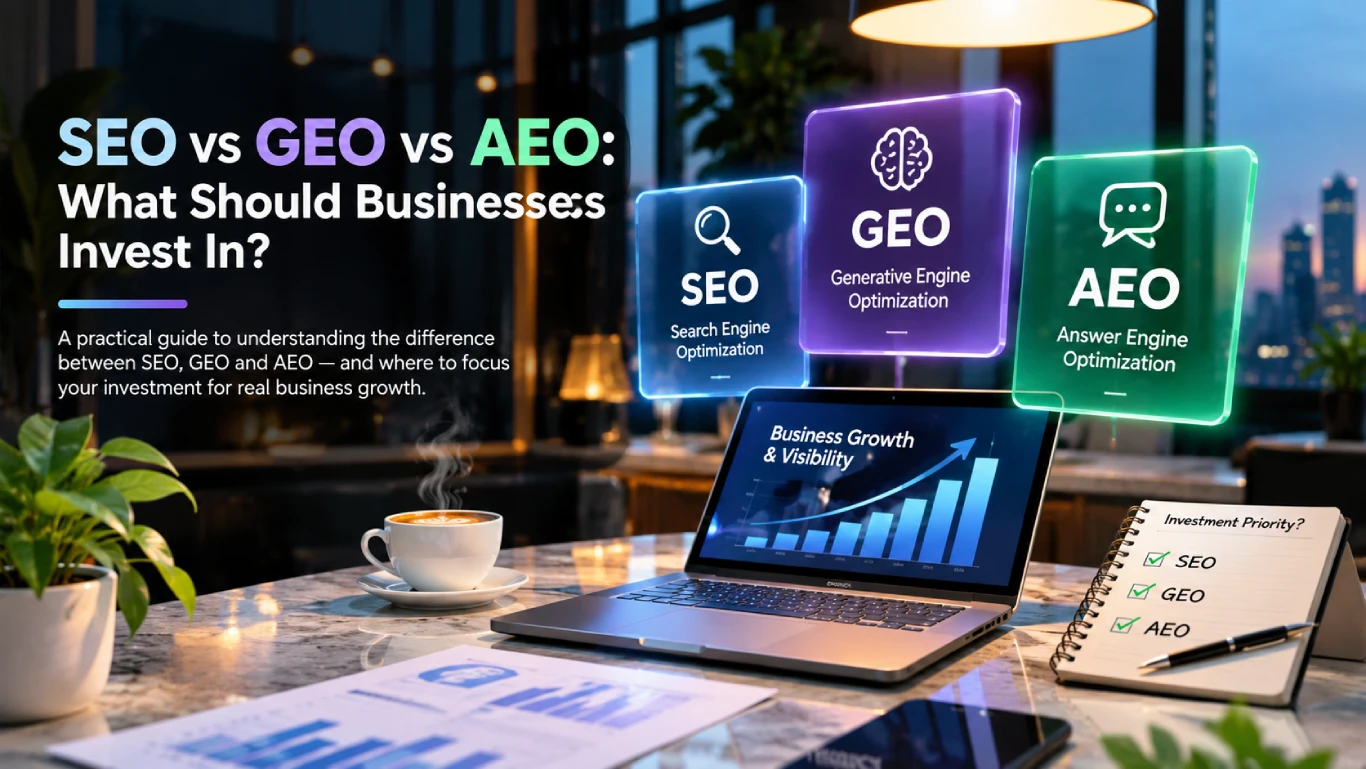
This shift has introduced three important concepts into digital marketing : Search Engine Optimization (SEO), Generative Engine Optimization (GEO) and Answer Engine Optimization (AEO).
For business owners, the real question is not simply what these terms mean. It is whether investing in SEO, GEO or AEO will generate better visibility, stronger brand recognition and more qualified business enquiries.
The answer depends on your business objectives, target audience, competition and current digital presence.
However, one principle is clear : businesses should not abandon traditional SEO to chase AI search trends. Instead, they should build a connected search strategy that makes their brand discoverable across traditional search engines and AI-powered answer experiences.
This guide explains the differences between SEO, GEO and AEO, how they work together, what businesses should priorities and how to build a practical investment strategy.
1. Understanding SEO, GEO and AEO
Although SEO, GEO and AEO share several techniques, they focus on different aspects of online visibility.
Understanding their individual purposes helps businesses allocate marketing resources more effectively.
What Is SEO (Search Engine Optimization)?
Search Engine Optimization is the process of improving a website's visibility in organic search engine results.
When someone searches for a service such as "digital marketing agency in Dubai" or "Shopify development company in Australia", search engines evaluate relevant pages and display results based on numerous quality, relevance and usability signals.
SEO helps businesses appear in these results when potential customers are actively searching for their products or services.
A comprehensive SEO strategy generally includes :
- Keyword Research: Identifying search terms that potential customers use when looking for products, services and business solutions.
- Technical SEO: Improving website crawlability, indexing, site structure, page performance and mobile usability.
- On-Page SEO: Optimising headings, page titles, meta descriptions, content and internal links.
- Content Strategy: Publishing useful, relevant and expertise-driven information that addresses customer requirements.
- Off-Page SEO: Building brand authority through relevant backlinks, industry mentions and credible external references.
- Local SEO: Improving visibility for location-based searches through relevant local business information and landing pages.
For example, a B2B company targeting Australian customers may want to rank for "digital marketing agency Australia".
A properly optimised service page, supported by relevant content, technical SEO and authoritative references, can help that business attract potential customers through Google.
The business objective of SEO : Generate relevant organic traffic, improve search rankings, build authority and attract potential customers who are actively looking for your services.
What Is GEO (Generative Engine Optimization)?
Generative Engine Optimization focuses on improving a brand's chances of being discovered, mentioned or cited in AI-generated responses.
Instead of displaying only a conventional list of web pages, generative AI platforms can synthesise information from multiple sources and provide conversational answers.
For example, a business owner might ask an AI platform :
"Which digital marketing agencies can help a B2B company generate qualified leads in Dubai?"
The AI system may produce a response that discusses relevant agencies, their services and supporting information.
GEO aims to make a business's website and wider digital presence useful, credible and understandable enough to be considered by these systems.
A practical GEO strategy includes :
- Creating original, well-researched and experience-based content.
- Establishing clear brand identity and consistent business information.
- Publishing detailed service pages that explain expertise and business outcomes.
- Earning relevant mentions from credible industry websites.
- Developing topical authority around specific services and industries.
- Using clear language, factual explanations and supporting evidence.
- Maintaining technically accessible and indexable website content.
GEO is particularly relevant to businesses that want to build visibility across AI-powered discovery experiences.
However, appearing in an AI-generated response cannot be guaranteed through a particular optimization technique. AI platforms use different systems, sources and selection processes.
The business objective of GEO : Improve brand discoverability, increase the chances of earning relevant AI citations and mentions, and strengthen visibility when potential customers research solutions through generative AI.
What Is AEO (Answer Engine Optimization)?
Answer Engine Optimization focuses on making website content clear, relevant and useful for systems that provide direct answers to user questions.
Traditional search often requires users to visit multiple websites to find information. Answer-oriented search experiences attempt to provide a direct response to a specific question.
Consider a customer searching :
"What should a business look for when hiring an SEO agency?"
A well-structured article that provides a clear, accurate and useful answer may be suitable for answer-oriented search experiences.
AEO focuses on improving how effectively content addresses specific questions.
Important AEO practices include :
- Writing clear, direct answers to relevant customer questions.
- Structuring articles with meaningful H2 and H3 headings.
- Creating informative sections that address specific search queries.
- Using descriptive page titles and relevant subheadings.
- Adding structured data where appropriate and accurate.
- Developing useful comparison guides and explanatory content.
- Addressing common questions throughout the customer journey.
For example, a web development company can create a detailed guide explaining website development costs, project timelines, technology choices and the factors that influence pricing.
This content can help potential customers understand their requirements while making the website more useful for search engines and answer-oriented experiences.
The business objective of AEO : Make useful information easier to understand, retrieve and present in direct-answer search experiences.
2. SEO vs GEO vs AEO: Key Differences
The three approaches are connected, but their primary objectives and measurement methods differ.
| Comparison Factor | SEO | GEO | AEO |
|---|---|---|---|
| Full Form | Search Engine Optimization | Generative Engine Optimization | Answer Engine Optimization |
| Primary Objective | Improve organic rankings | Improve AI-generated brand visibility | Improve direct-answer visibility |
| Main Focus | Search engine results | AI-generated recommendations and citations | Specific questions and answers |
| Content Approach | Keyword and topic-focused | Evidence-driven and authoritative | Clear, concise and answer-focused |
| Important Platforms | Google, Bing | ChatGPT, Gemini, Perplexity and AI search experiences | Featured snippets, answer experiences and voice search |
| Key Measurement | Rankings, traffic and conversions | AI mentions, citations and referral visits | Answer visibility and relevant search performance |
| Business Value | Organic discovery and leads | Brand recognition and AI discovery | Better access to useful answers |
It is important to understand that these categories overlap. AEO and GEO do not have universally agreed boundaries, and different marketers use the terms differently.
Google also explains that its AI search experiences continue to rely on foundational SEO principles.
Therefore, businesses should avoid treating these three approaches as completely independent marketing channels.
3. Why Traditional SEO Is Still Important in the AI Search Era
One of the biggest misconceptions in digital marketing is that AI search will make traditional SEO irrelevant.
This is not an accurate way to understand the transition.
Google's guidance on AI features confirms that foundational SEO practices remain relevant to AI Overviews and AI Mode. Pages must still meet Google's technical requirements and follow its search policies to be eligible for consideration.
This means businesses should continue investing in :
1. Technical Website Health
A website should be accessible to search engine crawlers, properly indexed and organised with a logical internal linking structure.
Important service pages should not be hidden behind complicated navigation or inaccessible website elements.
2. Helpful and Original Content
Publishing large volumes of generic articles is not a sustainable strategy.
Businesses need content that demonstrates expertise, addresses genuine customer problems and provides information that readers cannot easily find repeated across dozens of other websites.
3. Topical Authority
A company should build meaningful content around the services and industries it wants to be recognized for.
For example, a digital marketing agency offering SEO services should cover technical SEO, local SEO, keyword strategy, content optimization, website performance and conversion measurement.
4. Brand Credibility
Customers need reasons to trust a business.
Detailed service information, genuine case studies, transparent business details, relevant industry references and consistent communication all contribute to credibility.
5. Conversion Optimization
Visibility alone does not create business growth.
A website must also help visitors understand the service, evaluate the company and take the next step through a clear enquiry process.
The objective should be to turn relevant search visibility into measurable business opportunities.
4. How GEO and AEO Are Changing Digital Customer Discovery
The traditional customer journey often started with a Google search, followed by several website visits and a comparison between different providers.
AI-powered discovery introduces another research experience.
A potential customer can now ask more detailed questions, request comparisons, explore different solutions and receive a consolidated response.
This creates three important opportunities for businesses.
Opportunity 1 : Become Part of the Research Process
A customer may not initially know which service provider they need.
They might ask questions about the benefits of SEO, website redesign, lead generation or marketing automation.
Businesses that publish helpful educational content can become useful information sources during this early research stage.
Opportunity 2 : Strengthen Brand Recognition
When a company develops a consistent and credible online presence, it creates more opportunities for customers to encounter its brand across different discovery channels.
This includes organic search results, industry publications, relevant websites and AI-powered experiences.
Opportunity 3 : Influence High-Intent Decisions
Some customers use AI tools to compare service providers before contacting them.
They may want to understand pricing factors, technical capabilities, project experience and the differences between competing solutions.
Detailed service pages and credible supporting content can help a company communicate its expertise during this decision-making process.
For B2B businesses, this is particularly important because purchasing decisions often involve multiple stakeholders and a longer evaluation period.
5. SEO vs GEO vs AEO : Which Should Your Business Invest In?
There is no single investment formula that works for every company.
The right approach depends on your current website performance, business maturity, industry competition and customer acquisition goals.
Here is a practical way to approach the decision.
Invest in SEO First If Your Website Has Weak Organic Visibility
If your website is not ranking for relevant commercial keywords, start by addressing its SEO foundations.
Priorities :
- Technical SEO audits.
- Keyword research based on commercial intent.
- Service page optimization.
- Relevant industry content.
- Website performance and user experience.
- High-quality backlinks and brand references.
- Conversion tracking and lead measurement.
For a new business or a company with limited organic visibility, these activities create the foundation for long-term discoverability.
Invest in AEO If Your Customers Search Through Specific Questions
AEO can be a valuable addition when your industry involves detailed questions, comparisons and educational research.
For example, a business providing HR consulting services in Saudi Arabia could publish content addressing :
- What is the Saudization programme?
- What should businesses consider when planning employee compensation?
- How can organizations improve HR compliance?
The content should provide accurate and useful answers, not simply repeat keywords.
Invest in GEO If AI Discovery Is Important to Your Market
GEO becomes increasingly relevant when customers use AI platforms to explore providers, compare services or research business solutions.
Businesses should focus on :
- Building recognisable brand entities.
- Publishing expert-led information.
- Strengthening topical authority.
- Earning relevant third-party references.
- Maintaining consistent business information.
- Creating clear and evidence-backed service content.
GEO should be integrated with an established SEO and content strategy rather than treated as a shortcut to AI recommendations.
6. A Practical SEO, GEO and AEO Strategy for B2B Businesses
For most B2B companies, the strongest approach is to combine all three disciplines into one connected search visibility strategy.
Consider a company offering digital marketing services in Dubai.
Its potential customers may search for :
"SEO agency in Dubai"
"How much does SEO cost in the UAE?"
"Which digital marketing agency is suitable for B2B lead generation?"
"How can businesses appear in AI-generated search results?"
These searches represent different customer needs.
A connected strategy should address all of them.
Step 1: Build Commercial SEO Landing Pages
Create dedicated service pages for the services that generate revenue.
Examples include :
- SEO Services in Dubai
- Google Ads Management in UAE
- Website Development Services
- Shopify Development Services
- GEO and AI Search Optimisation
Each page should explain the service, target audience, business benefits, process and next steps.
Avoid creating multiple pages that target almost identical keywords without a meaningful difference in search intent.
Step 2: Create Supporting Educational Content
Develop blog articles around the questions customers ask before purchasing.
For example :
- SEO vs GEO vs AEO : What Should Businesses Invest In?
- How to Choose an SEO Agency in Dubai
- How to Measure SEO Performance Beyond Rankings
- Why B2B Websites Fail to Generate Qualified Leads
- How AI Search Is Changing Digital Marketing
Connect relevant articles to the appropriate service pages through contextual internal links.
Step 3: Improve Answer Readiness
Structure content so that important questions receive clear answers.
Use descriptive headings, concise explanations, comparison tables, practical examples and relevant FAQs.
Do not sacrifice depth simply to make paragraphs shorter. The objective is to communicate information accurately and clearly.
Step 4: Strengthen Brand Authority
Publish original research, expert insights, useful case studies and industry-specific content.
Seek relevant editorial mentions, partnerships and references from credible websites.
Avoid buying irrelevant backlinks or manufacturing brand mentions purely to influence AI systems.
Step 5: Measure Search Visibility Across Channels
Track organic performance and AI discovery separately wherever reliable measurement is available.
Use Google Search Console, Google Analytics 4 and appropriate AI visibility monitoring tools.
Connect this data with CRM information to understand whether search discovery is generating actual business enquiries.
7. How Should Businesses Allocate Their SEO, GEO and AEO Budget?
The investment decision should reflect the current maturity of the business rather than following a fixed industry percentage.
The following framework is an illustrative starting point, not a universal industry benchmark.
| Business Situation | SEO | GEO | AEO |
|---|---|---|---|
| New website | 70% | 15% | 15% |
| Established website with weak organic visibility | 65% | 20% | 15% |
| Strong organic presence | 45% | 30% | 25% |
| B2B thought-leadership brand | 40% | 35% | 25% |
These percentages represent a suggested allocation of search strategy effort, not guaranteed spending requirements or expected returns.
For a new website, technical health, keyword targeting and service page development should receive more attention.
For an established business with strong organic rankings, additional resources can be directed towards AI visibility, authoritative content and answer-oriented optimisation.
Before increasing the budget, businesses should identify which activities are already delivering measurable results.
8. How to Measure the Performance of SEO, GEO and AEO
A search visibility strategy should be evaluated using business outcomes, not just impressions or keyword rankings.
SEO Performance Metrics
Monitor :
- Organic clicks and impressions.
- Keyword ranking movements.
- Organic landing page traffic.
- Qualified organic enquiries.
- Conversion rate.
- Organic lead contribution.
- Revenue influenced by organic search.
Google Search Console helps businesses understand how their website performs in Google Search, while GA4 can help analyse website engagement and conversion activity.
GEO Performance Metrics
AI visibility is more difficult to measure consistently because different platforms may generate different responses to similar prompts.
Useful monitoring indicators include :
- Brand mentions in relevant AI responses.
- Frequency of citations to owned website pages.
- Competitor visibility across comparable prompts.
- AI referral traffic where identifiable.
- Engagement and enquiries from AI-referred visitors.
- Changes in brand representation across AI platforms.
Remember that manually checking a few AI prompts does not establish complete visibility. Results can vary based on the platform, query, context and time.
AEO Performance Metrics
Monitor :
- Featured snippet visibility where applicable.
- Search queries that trigger direct-answer experiences.
- Organic clicks and impressions for question-based queries.
- Performance of relevant answer-focused landing pages.
- Conversions generated by informational content.
Google Search Console can provide useful search performance information, but it does not provide a complete standalone measurement of every AEO or AI answer placement.
The most important metric across all three approaches is qualified business enquiries.
A website that attracts fewer but more relevant visitors may create more commercial value than one receiving large amounts of unrelated traffic.
9. Common Mistakes Businesses Should Avoid
As AI search optimisation becomes more popular, businesses can easily spend money on activities that offer little practical value.
Avoid these common mistakes.
Mistake 1: Abandoning Traditional SEO
GEO and AEO do not eliminate the importance of technical SEO, relevant content and website authority.
Mistake 2: Publishing AI-Generated Content Without Original Value
Content that repeats information already available across the internet offers little reason for users or search systems to prefer it.
Mistake 3: Treating Schema Markup as a Shortcut
Structured data can help search engines understand page content, but adding schema does not guarantee rankings, featured snippets or AI citations.
Mistake 4: Chasing AI Mentions Without Measuring Business Value
A brand mention is not automatically a qualified lead. Track referral activity, enquiry quality and business outcomes.
Mistake 5: Ignoring Website Conversion Experience
Even strong visibility can be wasted when a website has unclear service descriptions, confusing navigation or ineffective enquiry pathways.
Mistake 6: Believing Every New AI Optimisation Trend
Not every new technical recommendation is an official search requirement. Evaluate advice against platform documentation and real evidence before investing.
10. The Future of Search: Why Businesses Need a Connected Visibility Strategy
Search is becoming more conversational, contextual and integrated with AI-powered discovery.
Customers are no longer relying on one type of search experience to research every business decision.
Some will use traditional search engines to discover providers. Others will explore direct answers, AI-generated comparisons and recommendations before visiting a company website.
This does not mean traditional search is disappearing.
It means businesses need to understand how their potential customers discover information and make purchasing decisions across multiple channels.
The companies that build a strong digital foundation, communicate expertise clearly and maintain credible online identities will be better positioned to adapt to these changes.
For business leaders, the strategic priority should be to invest in sustainable search visibility rather than chasing individual optimisation trends.
SEO provides the foundation. AEO improves answer-oriented content. GEO extends the strategy towards generative AI discovery.
Together, they can support a more comprehensive digital acquisition strategy.
11. How WSA Digital Agency Helps Businesses Build Search Visibility
At WSA Digital Agency, we approach digital growth as more than improving website rankings.
A business needs to be discoverable, credible and capable of converting relevant visitors into genuine enquiries.
Our digital marketing and development capabilities support businesses looking to strengthen their online presence across competitive international markets.
Our services include :
Search Engine Optimization (SEO)
Technical SEO, keyword research, content optimization, website audits and organic search growth strategies.
Generative Engine Optimization (GEO)
Content authority, brand visibility, entity consistency and AI search discovery strategies.
Answer Engine Optimization (AEO)
Question-focused content, structured information and answer-oriented website optimization.
Website Development and Conversion Optimization
Business-focused website development, landing pages, technical improvements and conversion-focused user experiences.
Google Ads and Performance Marketing
Campaign strategy, lead generation, conversion tracking and performance optimisation.
Our approach begins with understanding your business model, target audience, competition and lead-generation objectives.
Rather than recommending every available digital marketing service, we focus on identifying the activities that can create meaningful commercial value for your business.
Whether your company operates in the UAE, Australia, UK or another international market, a well-planned search visibility strategy can help strengthen its digital presence.
Looking to improve your business visibility across Google and AI-powered search platforms?
Connect with WSA Digital Agency to discuss your SEO, GEO and AEO requirements and identify the right growth strategy for your business.
Build stronger search visibility. Attract the right audience. Generate better business opportunities.







Comments (0)
No comments yet. Share your technical feedback or questions below.
Leave a Technical Comment